University of Florida: Admissions, Rankings, and Student Life
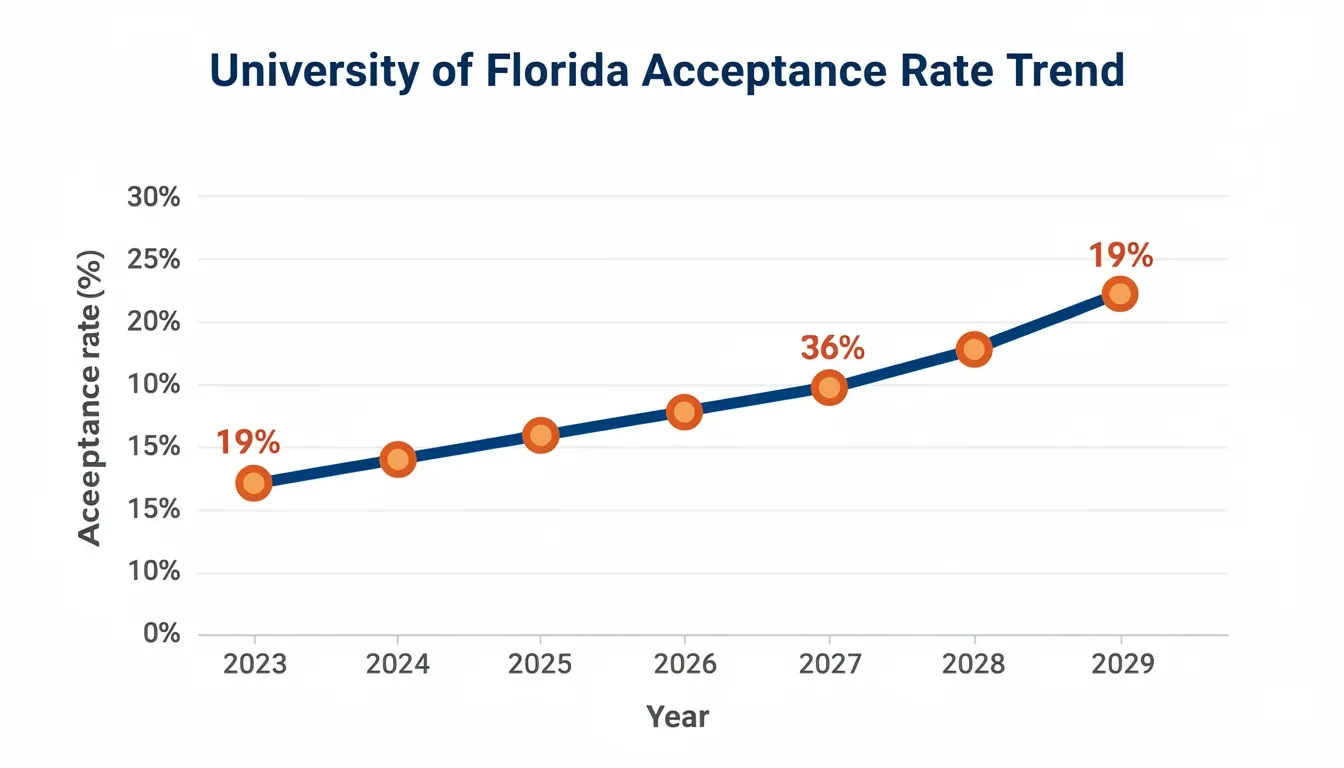
Six years ago, the University of Florida had a 30% acceptance rate. Last year, 91,896 students applied and only 18,169 got in. That's a 19% acceptance rate — a school that used to feel like a strong safety now competes in the same breath as Michigan and Virginia. If you're a prospective student or parent trying to figure out where UF actually sits, the answer is: higher than most people expect, and climbing.
How Competitive Is UF Right Now?
The acceptance rate drop is real and ongoing. In 2023, UF accepted roughly 30% of applicants. By the Class of 2029, that number had fallen to 19%. The application pool itself nearly doubled in under a decade — from around 47,000 total applications in 2018 to nearly 92,000 in the most recent cycle.
What's driving this? A few things. Florida's population is growing fast. The state's Bright Futures scholarship (which covers tuition for high-achieving Florida residents) keeps strong in-state students who might otherwise leave. And UF's national profile has risen enough to pull applicants from outside the Southeast.
The mid-50% SAT range for admitted students now sits at 1380–1510. ACT equivalent: 31–34. Those are not casual numbers.
| Metric | Class of 2029 |
|---|---|
| Total applicants | 91,896 |
| Admitted | 18,169 |
| Acceptance rate | ~19% |
| Mid-50% SAT | 1380–1510 |
| Mid-50% ACT | 31–34 |
| Transfer acceptance rate | ~47.8% |
One thing that surprises people: GPA distribution skews extremely high. About 39% of admitted students hold a perfect 4.0 unweighted GPA, and another 45% fall between 3.75 and 3.99. That leaves almost no room for anyone below 3.75. If you're hovering around 3.5, the math gets uncomfortable.
The Rankings Picture
UF ranked #7 among public universities in the 2026 U.S. News & World Report Best Colleges list, tied with the University of Texas-Austin. Overall, it sits at #30 nationally — meaning it outranks every other public school in the Southeast and competes directly with institutions like Carnegie Mellon (#22) and Georgetown (#26) in the broader national conversation.
Eight consecutive years inside the top 10 public universities. That's not a fluke — that's a sustained institutional trajectory that most flagship schools would trade for.
This matters for a specific reason: when employers screen resumes, they often use rough prestige tiers. A degree from a #7 public university carries weight in ways a #30 public school wouldn't. The gap between UF's overall rank (30) and its public rank (7) is unusually small, which means UF genuinely competes with private institutions despite the public school price tag.
The QS World University Rankings 2026 places UF at 212th globally, up from 215th the prior year. Solid, though not what defines the school's appeal.
What UF Actually Weighs in Applications
UF describes GPA, rigor of coursework, and essays as "very important." Test scores, extracurriculars, and character are listed as "important." The school does not publish separate acceptance rates for Early Action vs. Regular Decision — it quietly introduced Early Action for the first time with the Class of 2027 — but the early read from admissions counselors is that applying early signals genuine interest.
Rigor of coursework matters more than most applicants realize. A 4.0 built on standard courses looks weaker than a 3.8 built on AP and dual enrollment. UF admits students who have pushed their high school's academic ceiling, not just floated to the top of whatever was available.
A few non-obvious points worth knowing:
- In-state students make up 85–90% of each incoming class. Out-of-state and international applicants face a steeper climb, with acceptance rates around 20% — lower than the published overall rate.
- Transfer students have a more favorable path: the transfer acceptance rate runs around 47–48%, and UF actively recruits from Florida's state college system through the Florida Pathways program.
- Florida residents with strong Bright Futures eligibility have a built-in financial incentive to pick UF over out-of-state schools, which means more competition from within the state — not less.
The Rankings Behind the Rankings
UF's rise isn't just about admissions selectivity. The research output has become remarkable. In fiscal year 2025, UF faculty conducted a record $1.33 billion in research spending — more than the annual operating budgets of most mid-sized universities. New awards hit $1.25 billion that same year, including $818 million from federal sources.
The breakdown tells a story about where UF's real strengths live:
- UF Health (six colleges combined): $369.4 million in research spending
- UF/IFAS (agriculture and natural resources): $286.5 million
- Herbert Wertheim College of Engineering: $181.6 million, across cybersecurity, semiconductors, and robotics
Agriculture is a less-hyped but legitimately world-class program. UF/IFAS has been the national leader in agricultural science research for six straight years. If you're interested in food systems, environmental science, or plant biology, there are few better places in the country to do serious undergraduate research.
The school has also poured significant funding into AI and quantum research over the past several years — areas where having access to active research infrastructure as an undergraduate is genuinely rare.
Student Life: What 50,000 People on One Campus Looks Like
With over 50,000 enrolled students, UF is one of the largest universities in the country by headcount. That scale creates both opportunity and noise.
The organization count alone is staggering: 1,300+ student groups. That's not a marketing number padded with dead clubs — UF has active chapters for everything from political advocacy to obscure academic disciplines to recreational sword fighting (yes, really). For students who show up wanting to find their people, the infrastructure exists.
A few things that define the UF experience more than the brochure admits:
- The Swamp is not a metaphor for how football feels. Ben Hill Griffin Stadium holds 88,548 people and gets genuinely loud. Fall Saturdays in Gainesville during SEC football season are a cultural event unto themselves. Students who don't like football still feel it — the entire city pivots.
- Lake Wauburg offers free outdoor recreation including kayaking, paddleboarding, and rock climbing. It's 20 minutes from campus and underutilized by a surprising number of students who never discover it.
- The student government (SG) runs free events throughout the year — carnival nights, movie screenings, free concerts — funded by a student activity fee that's included in tuition.
Housing is the honest asterisk. Many residence halls are older and show it. Students report issues with mold, aging plumbing, and maintenance backlogs in some buildings. The university has been renovating steadily, but if you're comparing UF dorms to newer private university housing, you'll notice the difference. Most upperclassmen end up in off-campus apartments in the neighborhoods around campus, which are plentiful and generally affordable by Florida standards.
Living in Gainesville
Gainesville gets undersold. People hear "college town in north-central Florida" and picture something sleepy. What they find is a mid-sized city of about 135,000 people that has developed around the university for 170 years.
The restaurant and bar scene is real. Downtown Gainesville and the areas near campus have enough variety to sustain four years without repeating yourself. The live music circuit is active — partly because touring acts heading between Miami and Atlanta often stop — and the city hosts an annual arts festival called the Gainesville Fine Arts Festival that draws regional attention.
The cost of living is low by any Florida standard. Median rent for a two-bedroom near campus runs well under Tallahassee or Tampa, which matters when you're budgeting for four years. Students from Miami or Orlando often experience genuine sticker shock (the positive kind) when they price out apartments.
Florida's weather is the elephant in the room. Gainesville summers are hot and humid — real humidity, not the dry kind. August and September are rough for anyone not acclimated to the Southeast. But the winters are genuinely mild. The trade-off is a calendar that runs almost no snow days, which most students seem willing to make.
Career Outcomes and the C3
UF's Career Connections Center (C3) has been ranked the #2 career center in the country by Best Colleges (Princeton Review's methodology). That's not just a feel-good distinction — it reflects real employer relationships. UF has been cultivating ties with Florida's aerospace industry, Disney, and the state's growing tech corridor for decades.
For in-state students, UF's network in Florida is practically unmatched. The alumni base across state government, healthcare, and Florida-based corporations is massive. For students aiming to leave Florida, the brand travels reasonably well nationally — particularly in business, engineering, and health sciences.
The university also has an undergraduate research program called UF Undergraduate Research (UFUR) that gives students access to faculty labs across disciplines. The $1.33 billion research operation means there are actual opportunities, not just marketing copy.
Bottom Line
- UF's acceptance rate is now 19% with a class median SAT around 1445. If you're applying without a 3.75+ unweighted GPA and strong course rigor, build a more conservative list.
- The #7 public university ranking is legit and has held for eight straight years — at in-state tuition, the value proposition is hard to beat in the Southeast.
- Apply Early Action. UF just introduced it, and demonstrated interest matters more when a school is managing a 92,000-applicant pool.
- If you're an in-state transfer student, the 47–48% transfer acceptance rate makes UF a realistic target that straight-from-high-school applicants don't have access to.
- Student life at 50,000+ students means you have to be proactive. The opportunities (1,300 clubs, free outdoor recreation, strong career services) only pay off if you go looking for them.
Frequently Asked Questions
Is the University of Florida hard to get into?
Yes, and it's gotten harder quickly. The acceptance rate dropped from around 30% in 2023 to roughly 19% for the Class of 2029. The middle 50% of admitted students scores between 1380 and 1510 on the SAT, with unweighted GPAs overwhelmingly above 3.75. UF is no longer a safety school for most applicants.
Does applying Early Action improve your chances at UF?
UF introduced Early Action for the first time with the Class of 2027, and the university hasn't published separate acceptance rates by decision type. That said, applying early signals interest and generally allows UF to build its class with more planning. Most admissions advisors recommend applying EA if UF is a genuine target school.
What are the strongest academic programs at UF?
Engineering (particularly the Herbert Wertheim College of Engineering), agriculture and food science through UF/IFAS, and the health sciences colleges are where UF's research output is most concentrated. The business school (Warrington College of Business) is well-regarded for finance and real estate. UF has also been investing in AI and quantum research infrastructure since roughly 2019.
Is UF a party school?
The honest answer: it's a large SEC school, so the social scene is active. Football weekends are significant events, and the Greek system (one of the largest in the Southeast) is visible. But UF has also sustained a top-10 public university ranking, which requires real academic rigor. Students who want to party can. Students who want to do serious research can. Both populations coexist.
How does living in Gainesville compare to other Florida college cities?
Gainesville is cheaper than Miami, Tampa, or Orlando by a significant margin. The city has a real downtown, a live music scene, and enough restaurants and bars to feel like a proper college town. The downside is the summer heat — August in Gainesville is genuinely brutal for anyone arriving from outside the South. Once you're past October, the weather becomes one of the better arguments for the school.
Can out-of-state students realistically get into UF?
Yes, but the math is harder. In-state Florida students make up 85–90% of each incoming class, and out-of-state applicants face an acceptance rate closer to 20% than the published overall figure. The upside for in-state students is Bright Futures scholarship eligibility, which can cover a substantial portion of tuition — that policy creates intense in-state competition but also keeps UF affordable for Florida residents who get in.
Sources
- Eight years and counting: UF continues to hold its place among U.S. News top public universities
- UF Acceptance Rate 2026: How Competitive Are Admission, GPA, and SAT Requirements
- University of Florida research spending at record $1.33 billion for FY2025
- What's campus life like at the University of Florida?
- U.S. News & World Report keeps University of Florida as No. 7 in the nation
- University of Florida Acceptance Rate: Admissions Statistics