The Most Sustainable Colleges in 2026: What the Rankings Actually Show
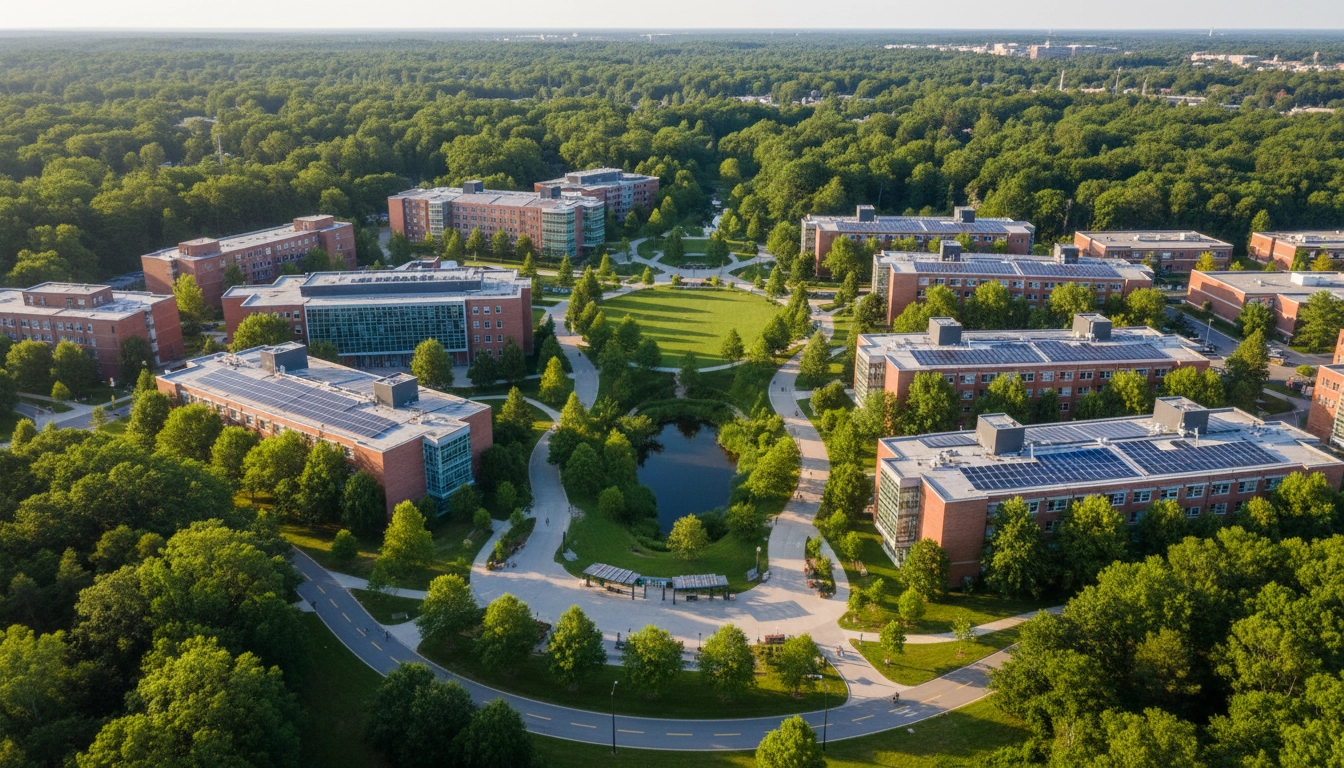
When the College of the Atlantic in Bar Harbor, Maine became the first U.S. college to achieve carbon neutrality back in 2007, the bar felt almost radical. Today, that same school claims the top spot in the Princeton Review's 2026 Guide to Green Colleges for the tenth consecutive year — and the rest of higher education has spent those years scrambling to catch up. What's changed isn't the aspiration. It's the scale, and increasingly, the scrutiny.
Three Ranking Systems, Three Different Questions
When you search "most sustainable colleges," you'll hit at least three major systems: the Princeton Review's Green Guide, the QS World University Rankings for Sustainability, and AASHE's Sustainable Campus Index powered by the STARS rating framework. All three measure sustainability. None of them are measuring the same thing.
The Princeton Review focuses on individual campus behavior — renewable energy percentages, waste diversion rates, whether a school has a sustainability officer, and what students actually experience day to day. QS leans toward research output and global influence: how much a university's published work shapes sustainability knowledge worldwide. STARS is the most granular, a self-reported point-based system spanning operations, academics, and community engagement.
Choosing a school based on one list without knowing what it measures is like comparing Michelin stars to Yelp reviews. Both are valid. They're counting different things.
Princeton Review's 2026 Top Green Colleges
The Princeton Review surveyed administrators at 401 institutions for its 2026 edition, profiled 388 of them, and ranked the top 50. The methodology rests on 25 survey questions covering sustainability policies, practices, and student support.
College of the Atlantic takes the #1 spot again. The institution is unusual by design: it awards exactly one degree, a Bachelor of Arts in Human Ecology, and every student spends four years engaging with how humans interact with the natural world. It hit carbon neutrality in 2007 and is targeting fossil fuel-free operations by 2030.
American University in Washington, D.C. holds second. Its Sustainability Strategic Plan 2030 lays out 113 specific goals across six focus areas, and AU hit carbon neutrality in 2018 — two years ahead of its self-imposed deadline.
Here's the complete top 10 from the 2026 Princeton Review guide:
| Rank | School | Location |
|---|---|---|
| 1 | College of the Atlantic | Bar Harbor, ME |
| 2 | American University | Washington, D.C. |
| 3 | Lehigh University | Bethlehem, PA |
| 4 | Loyola Marymount University | Los Angeles, CA |
| 5 | Bennington College | Bennington, VT |
| 6 | UC Santa Cruz | Santa Cruz, CA |
| 7 | UC Merced | Merced, CA |
| 8 | University of Cincinnati | Cincinnati, OH |
| 9 | UMass Amherst | Amherst, MA |
| 10 | Stevens Institute of Technology | Hoboken, NJ |
Thirty-seven schools across all 388 profiled institutions earned a perfect Green Rating of 99, landing them on the Princeton Review's Green Honor Roll.
QS Global Sustainability Rankings: The International Picture
The QS World University Rankings: Sustainability 2026 covers more than 2,000 institutions across 106 countries. The framework weights environmental impact, social governance, and research contributions together — a much broader lens than campus operations alone.
Sweden's Lund University claimed the global #1 position in 2026, displacing the University of Toronto, which had held the top spot for two years. UCL moved up to third, and the UK placed five schools in the global top 10.
For U.S.-based students, the picture is mixed. Sixteen American universities landed in the global top 100, which sounds impressive until you note that the U.S. entered 240 institutions total. UC Berkeley is America's highest-ranked school at 11th globally, followed by NYU at 20th and Penn State at 21st.
The QS rankings reward research volume, which naturally advantages large research universities. A small liberal arts college doing genuinely excellent environmental work may not appear in QS at all, while a large state school with sustainability publications but a gas-heavy campus can rank surprisingly well.
STARS: The Rating System That Digs Deepest
AASHE's Sustainability Tracking, Assessment & Rating System is the closest thing higher education has to an independent audit. Schools self-report data across energy consumption, curriculum, transportation, and community partnerships, and earn points. Ratings run from Bronze to Silver to Gold to Platinum.
Platinum is the hardest to achieve and the most credible. A school can't simply offset its way there — it has to perform across every dimension STARS measures.
UC Merced, UC Irvine, UC Berkeley, and Stanford are among the few California schools to have earned Platinum ratings. UC Merced is notable because it opened in 2005 as the first new research university of the 21st century, built with sustainability as a founding principle rather than a retrofit. The campus runs a 5-megawatt solar carport system with battery storage (not a minor installation for a mid-sized campus).
One caveat worth knowing: STARS ratings require periodic renewal, and a Platinum rating from 2022 doesn't necessarily reflect 2026 operations. The system just rolled out STARS 3.0 with updated criteria. When evaluating a school, always check the timestamp on their rating.
What's Actually Happening on These Campuses
The aggregate statistics from the Princeton Review's 2026 guide tell an interesting story. Across 388 profiled schools:
- 18% of energy comes from renewable sources
- 38% of waste is diverted from landfills or incinerators
- 94% employ a dedicated sustainability officer
- 98% offer at least one sustainability-focused undergraduate program
Those numbers aren't bad. But 18% renewable energy also means 82% is still conventional. That gap is where the real work is happening — and where the distance between stated goals and actual operations is most visible.
Carbon neutrality commitments vary wildly in ambition and honesty. Catawba College in Newton, North Carolina achieved full carbon neutrality seven years ahead of its 2030 target. Swarthmore College is mid-execution on a $69 million Energy Master Plan that includes geothermal heat exchange and on-site battery storage. Harvard set a target for fossil fuel neutrality by 2026; Cornell's Climate Action Plan targets full carbon neutrality by 2035.
The honest reality is that most schools are still building toward their goals. Even top-ranked schools may be purchasing renewable energy credits rather than generating clean power on-site. Credits count in rankings. They don't always decarbonize a grid.
What Students Should Actually Look For
The gap between "we have a sustainability program" and "we run a meaningfully sustainable campus" is wider than most prospective students realize. Here's a practical framework for evaluating schools beyond their ranking position.
- Look at the energy source. Ask what percentage of on-site energy comes from renewable generation (solar, wind, geothermal) versus purchased renewable energy credits. On-site generation is harder to fake.
- Check the major depth. If you want to study environmental science or sustainability policy, curriculum rigor matters more than how many solar panels the dining hall has.
- Read the climate action plan. Schools serious about sustainability publish them, update them, and make them public. A PDF from 2019 with no revisions is a signal.
- Look at student organizations. Sustainability groups with real budget authority and public deliverables indicate an institutional culture that goes beyond PR.
- Check the STARS rating timestamp. A school bragging about a STARS Gold rating from 2021 under the old version 2.2 methodology may look quite different under the current 3.0 framework.
According to the Princeton Review's 2025 College Hopes & Worries Survey, 59% of students said a college's environmental commitment would affect their school selection. Schools know this, which means marketing language around sustainability has gotten very good — sometimes better than the underlying operations deserve.
The Student Demand Signal Is Changing Institutions
That 59% figure matters beyond individual decisions. It's reshaping how universities allocate resources and what they build. Ten years ago, a sustainability office was a small team with a small budget.
Today, 94% of the 388 schools in the Princeton Review's 2026 guide employ a dedicated sustainability officer. That's a structural shift. Some schools are responding with substance. Macalester College in St. Paul, Minnesota (ranked 18th in the guide) completed a 100% renewable electricity commitment before its own deadline. Dickinson College in Pennsylvania (23rd) has run sustainability programs since the late 1990s, long before rankings existed to reward it.
Others are responding with messaging. The tell is usually whether a school's claims are specific and falsifiable ("we generated 6.3 megawatt-hours on-site in 2024") or vague and aspirational ("we're committed to a greener future"). One is a data point. The other is a press release.
Bottom Line
Sustainable schools in 2026 range from genuinely transformative campuses to very well-marketed ones. Here's what to do:
- Use multiple rankings. The Princeton Review, QS, and STARS each surface different strengths. A school that scores well across all three is probably doing something real.
- Verify, don't trust. Ask for a school's current STARS rating with the submission date and raw score breakdown — not just the letter grade.
- Match your goals. If you want to study sustainability, look at curriculum depth. If you want to live on a sustainable campus, look at operations data.
- Don't overlook smaller schools. College of the Atlantic wins by being consistent, specific, and built around a single integrating idea. Bigger does not mean greener.
The single most important takeaway: a school's STARS rating, its position in the Princeton Review's Top 50, and its published climate action plan together tell a more complete story than any single number. Ask for all three before you commit.
Frequently Asked Questions
Which college is ranked the most sustainable in the US for 2026?
College of the Atlantic in Bar Harbor, Maine holds the #1 spot in the Princeton Review's 2026 Guide to Green Colleges — the tenth consecutive year it has claimed the top position. The school was also the first U.S. college to achieve carbon neutrality, which it did in 2007, and it's now targeting fully fossil fuel-free operations by 2030.
What is the difference between the Princeton Review Green Guide and QS Sustainability Rankings?
The Princeton Review focuses on campus operations and student experience: renewable energy, waste diversion, sustainability programs, and student culture. QS measures research output and global influence on sustainability knowledge. A small liberal arts college can rank #1 in the Princeton Review and not appear in QS because it publishes little academic research; a large research university can rank highly in QS while still running a carbon-heavy campus.
Do renewable energy credits count toward sustainability rankings?
Yes, in most systems — and this is a real limitation. A school can purchase renewable energy credits (RECs) to offset fossil fuel consumption without generating any clean power on-site. STARS differentiates between on-site generation and purchased credits in its scoring, but both count toward totals. Always ask how much of a school's renewable energy is actually generated on campus.
Is a STARS Platinum rating from 2022 still valid in 2026?
Not necessarily. STARS ratings require renewal every few years, and the system just launched version 3.0 with updated criteria. A school's 2022 Platinum rating under STARS 2.2 reflects a different measurement standard than the current framework. Check the submission date on any school's STARS report before treating the rating as current.
How much does a school's sustainability record matter for students who aren't studying environmental fields?
More than most people assume. Campus food systems, transportation, building standards, and waste reduction programs affect daily life for every student on campus. And for students entering sustainability-adjacent fields — urban planning, public health, business — a school's demonstrated commitment to its own operations serves as a living case study worth paying attention to.
What are some overlooked green schools outside the top 10?
Catawba College in North Carolina achieved full carbon neutrality seven years ahead of its target, which is an actual operational achievement rather than a projection. Randolph College in Virginia (14th in the Princeton Review guide) is smaller and less well-known than many schools ranked above it. Luther College in Iowa (24th) runs a student-managed sustainability fund that gives undergraduates real decision-making authority over green investments.
Sources
- The Princeton Review's Guide to Green Colleges — 2026 Edition Press Release
- Princeton Review Top 50 Green Colleges 2026
- QS World University Rankings: Sustainability 2026
- AASHE Sustainable Campus Index
- STARS — Sustainability Tracking, Assessment & Rating System
- FM College: Report Ranks Top 50 Green Colleges
- 16 U.S. Schools Rank in QS Sustainability Top 100