Michigan State University: Admissions, Rankings, and Student Life
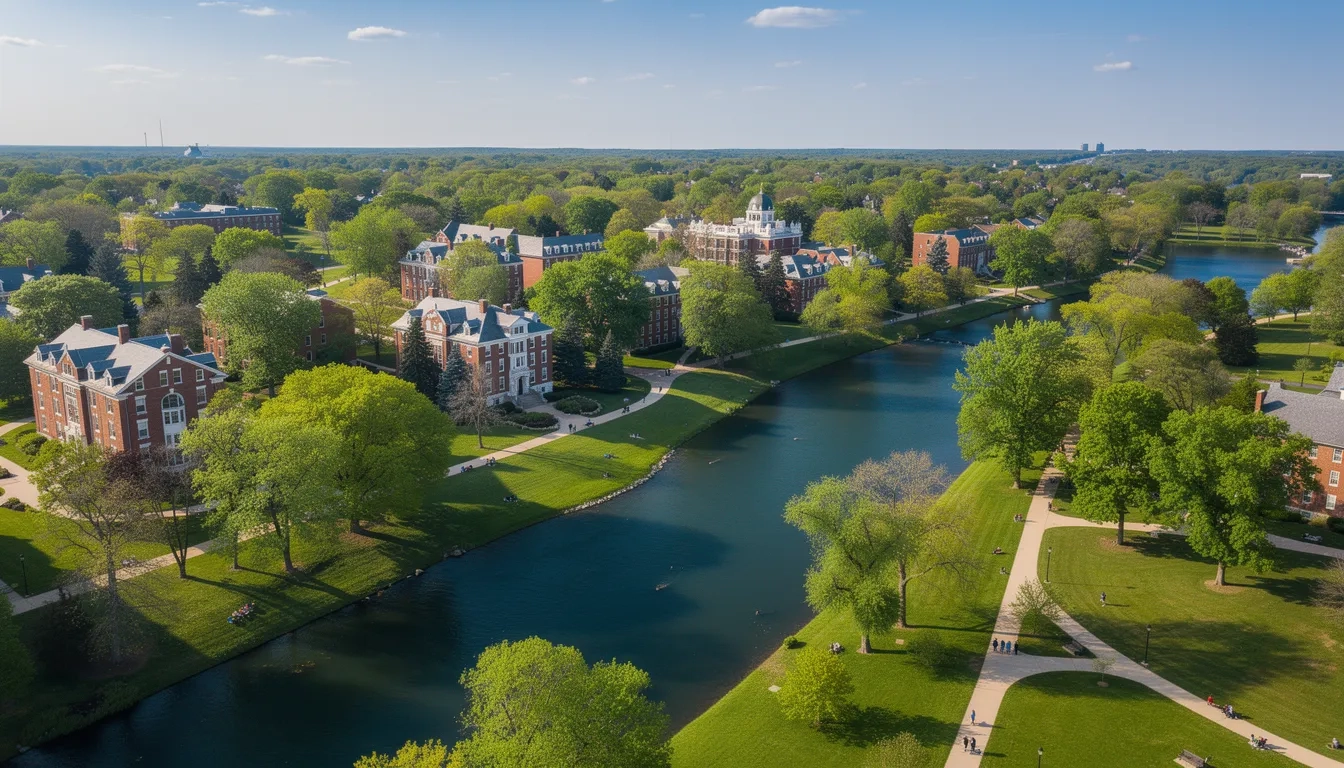
Michigan State's 5,192-acre campus in East Lansing is so large that first-year students sometimes need a few weeks to stop getting turned around. That scale is intentional. MSU was founded in 1855 as a land-grant institution — built to serve people, not just to look prestigious — and everything from its residential structure to its academic priorities reflects that original mandate.
With fall 2025 enrollment hitting 51,838 students (the second-largest in the school's history), MSU is one of the ten biggest universities in the country by headcount. Whether that scale is an asset or a liability depends entirely on what you need from a college experience. Here's what the data actually shows.
Who Gets In and What It Takes
MSU's acceptance rate sits around 84.8%. In one recent admissions cycle, 62,138 students applied and 52,690 were admitted. That places MSU in the accessible range for a flagship public research university — not a safety school by any definition, but not a long-shot reach unless your academic profile falls well below the admitted range.
The middle 50% of admitted students look like this:
| Metric | 25th Percentile | 75th Percentile |
|---|---|---|
| High School GPA | 3.5 | 4.0 |
| ACT Composite | 26 | 31 |
| SAT Total | 1100 | 1320 |
MSU remains test-optional and will continue that policy through the 2025-26 cycle. Skipping scores isn't a penalty — but it shifts weight onto your GPA and course rigor, both of which MSU lists as its highest-priority factors. The admissions office rates GPA "very important" and rigor of coursework "important." That hierarchy is reflected in who actually enrolls.
The strongest MSU applications pair a solid academic record with a course load that pushed the student — AP, IB, dual enrollment, something that signals genuine ambition rather than an easy path to a high GPA.
What's somewhat unusual for a school this size: MSU explicitly considers "leadership, talents, conduct, and diversity of experience" alongside grades. That language isn't boilerplate at MSU. Students with nontraditional backgrounds or standout community contributions get real consideration, not just lip service.
Recommended high school coursework:
- English: 4 years
- Mathematics: 3 years
- Social Studies: 3 years
- Science: 2 years
- Foreign Language: 2 years (single language)
A gap in one area won't automatically disqualify an application, but MSU's admissions page is direct: "a less rigorous curriculum will put these applications at a disadvantage." Refreshingly honest for a large admissions office.
One practical note: the Fall 2026 application cycle is already closed. Fall 2027 applications open in August 2026. If you're planning ahead, mark the calendar now.
Rankings: The Full Picture
The headline number for 2026 is #64 overall among national universities and #29 among public institutions, according to U.S. News & World Report. That's the third consecutive year MSU has held a top-30 public ranking — a genuine trend. But aggregate rank is the least useful number here.
The real story is at the program level. The Broad College of Business's supply chain management program has ranked #1 nationally for 15 consecutive years. That kind of sustained dominance reflects faculty depth, industry relationships, and a placement pipeline that compounds over time (it's the kind of result that doesn't happen by accident). Programs like this are often worth more than their rank implies.
Six MSU undergraduate programs ranked in the national top 25 for 2026:
- Supply Chain Management — #1 nationally (15th consecutive year)
- Production/Operations — #7 nationally, #4 among public universities
- Management — #16 nationally, #10 among public universities
- International Business — #21 nationally, #9 among public universities
- Accounting — #22 nationally, #13 among public universities
- Undergraduate Business — #24 nationally, #14 among public universities
At the graduate level, MSU's College of Education is quietly one of the strongest in the country. Four programs rank #1 nationally — two of which have held that position for over 30 years. Nine of the college's ten programs rank in the top 10. If you're heading toward K-12 teaching, school leadership, or educational research, MSU belongs near the top of your list.
Education abroad is another genuine strength that rarely shows up in rankings conversations. MSU has ranked #1 among public universities for education abroad for seven consecutive years, according to MSUToday's reporting on the 2026 rankings. Over 3,000 Spartans study internationally each year. For a student who wants serious global exposure without leaving a Big Ten institution, the numbers back it up.
One honest counterpoint: MSU's overall rank puts it in a tier where brand recognition can be a real factor. If you're entering a field where employer familiarity with your school's name matters more than program-specific strength, that gap exists. But for business, education, or global career tracks, MSU frequently outperforms schools ranked 20 places above it.
Housing: Neighborhoods, Not Just Dorms
MSU's residential system is well-designed for a campus its size. Twenty-seven residence halls are organized into five neighborhoods, each with its own embedded dining, academic support, health services, and programming. The goal is to make a 50,000-person university feel like a collection of smaller communities — and it mostly works.
First-year students are generally required to live on campus and receive an unlimited dining plan covering 30+ locations across campus. Each neighborhood has its own dining identity, which means students can explore different halls rather than eating at the same place every day for eight months. That might sound like a minor thing, but after month three, it matters.
Beyond standard residence halls, MSU offers two apartment communities including 1855 Place, a student housing complex with apartments and townhouses for upper-division students and students with families. The variety reflects an understanding that not every 19-year-old wants or needs the traditional communal hall setup.
A few things worth knowing before choosing housing:
- Proximity to your primary college's buildings matters more than students typically anticipate when selecting a neighborhood
- The academic support centers embedded in each neighborhood — staffed by tutors and advisors — are genuinely useful, not just a line in the housing brochure
- On-campus housing rates vary by hall type; reviewing current rates on MSU's Live On portal before committing is worth the 20 minutes
Student Life at Scale
MSU has over 900 registered student organizations. At a school with 51,000 students, that creates real density of options. Organizations here often carry enough members to run serious events, maintain institutional history, and connect students to alumni networks. The writing was on the wall for any notion of MSU as a place where students just float through anonymously — the infrastructure for involvement is genuinely well-built.
Service learning is a consistent standout. MSU ranks in the top 10 nationally for service learning and holds the #1 public university spot, according to U.S. News & World Report's student engagement categories. That means the connections between coursework and community engagement are structurally embedded — baked into how programs are designed, not just available as an optional add-on.
The MSU Student Food Bank distributed over 110,000 pounds of food to more than 6,000 students in a single year. For a large public university serving a wide economic range of students, that kind of concrete infrastructure matters more than most prospective students think to ask about.
The Multicultural Center is currently under construction and nearing completion, reflecting an investment in inclusive programming that goes beyond statements.
One honest note for incoming students: 900 organizations can be paralyzing. Students who arrive with even a provisional sense of one or two communities they want to explore tend to find their footing significantly faster than those who wait for something to catch their eye.
Athletics and the Big Ten Identity
Spartan Stadium holds 75,005 fans. On a home football Saturday, that's roughly one and a half times the entire population of East Lansing. If you haven't experienced a Big Ten game day, there's no good way to describe it in text.
MSU competes in the Big Ten Conference across dozens of varsity sports, and the athletic culture shapes campus identity in ways that extend well past the playing surface. The alumni network is partly organized around Spartan fandom. Employer recognition in the Midwest is tied to it. The social calendar for many students revolves around it — even for students who don't follow sports closely.
For students who thrive in that environment, it's hard to beat. For students who genuinely don't want big-sports culture as a backdrop to their college life, MSU's scale and diversity of organizations mean there are real pockets of campus disconnected from athletics entirely. Both groups can find their place here.
Non-varsity students access IM West and IM East recreational centers through the Rec Sports Passport program: weight rooms, cardio equipment, group fitness classes, and indoor pools. These are serious facilities, not afterthoughts.
Why MSU Deserves More Credit Than It Gets
Here's a position worth taking: MSU gets undersold because its reputation lags its actual academic record. The supply chain program has led the nation for 15 years. The education graduate programs have held #1 spots for over three decades. The global education infrastructure outperforms dozens of schools with higher overall rankings. That gap between perception and reality is real.
The drawback is equally real. A 50,000-student institution requires students who are genuinely self-directed. Advisors are stretched. Introductory courses can be large. Students who wait for the university to organize their experience for them often feel lost by November of freshman year.
But students who arrive knowing their target program and willing to seek out the communities that matter to them — those students get elite program quality, a nationally recognized research environment, Big Ten culture, and a global education infrastructure, all at a public university price. That combination is rarer than the rankings suggest.
Bottom Line
- Apply if you're in range: A 3.5+ GPA with a rigorous course load puts you in strong position. Test-optional is genuine; skip scores if they'd hurt you.
- Target program-specific strength: If supply chain, business, or education are in your plans, MSU's program rankings frequently exceed what the overall #64 would suggest.
- Engage early and deliberately: At 50,000+ students, your experience is proportional to how intentionally you build it. Pick one or two organizations before you arrive.
- Take the residential neighborhood system seriously: Where you live shapes your first year more than most students anticipate. Research the neighborhoods before accepting a housing placement.
- Watch for the Fall 2027 application window: It opens in August 2026. Early preparation — particularly on GPA and course load documentation — makes a real difference.
Frequently Asked Questions
Is Michigan State University hard to get into?
MSU's acceptance rate is approximately 84.8%, making it accessible by research university standards. The middle 50% of admitted students have GPAs between 3.5 and 4.0 and ACT scores between 26 and 31. Strong applicants with a challenging course load and solid extracurricular involvement are well-positioned.
Does Michigan State require SAT or ACT scores?
No. MSU is test-optional and will remain so for the foreseeable future. Students who choose not to submit scores will have greater emphasis placed on their GPA, course rigor, and application essay. Submitting scores only makes sense if they strengthen your application relative to your academic record.
What is Michigan State actually ranked #1 for?
MSU's supply chain management undergraduate program (housed in the Broad College of Business) has ranked #1 nationally for 15 consecutive years. At the graduate level, four programs in the College of Education rank first in the nation, two of which have held that distinction for over 30 years. MSU also ranks #1 among public universities for education abroad programs.
What's the social scene like at Michigan State?
MSU has a strong Big Ten athletic culture and a well-documented social scene centered around football Saturdays and campus events. The school has historically carried a reputation as a party school — which has some basis in reality but applies to one segment of a very large campus. With 900+ organizations and five distinct residential neighborhoods, students who want a different kind of social environment have real options.
How does campus housing work at MSU?
First-year students are generally required to live on campus and are automatically placed on an unlimited dining plan. MSU's 27 residence halls are grouped into five neighborhoods, each with embedded dining, academic support, and health services. Students can also apply for apartment-style housing through communities like 1855 Place starting in their sophomore or junior year.
Is Michigan State a good choice for out-of-state students?
It depends heavily on your program. Out-of-state tuition at MSU is significantly higher than in-state rates, so program-specific ranking matters. For supply chain, education, or international business, MSU's national standing makes out-of-state costs potentially worth it. For more general programs where MSU's overall rank is the primary appeal, comparing cost against in-state alternatives is worth doing carefully.
Sources
- MSU boasts 6 undergraduate programs among best in nation | MSUToday
- MSU graduate programs earn several No. 1 and top 10 rankings | MSUToday
- First-year admission criteria | Michigan State University
- Strong student demand pushes MSU to near-record enrollment | MSUToday
- Campus Life | Live On - Michigan State University