Liberal Arts Graduate Salaries 2026: What the Data Shows
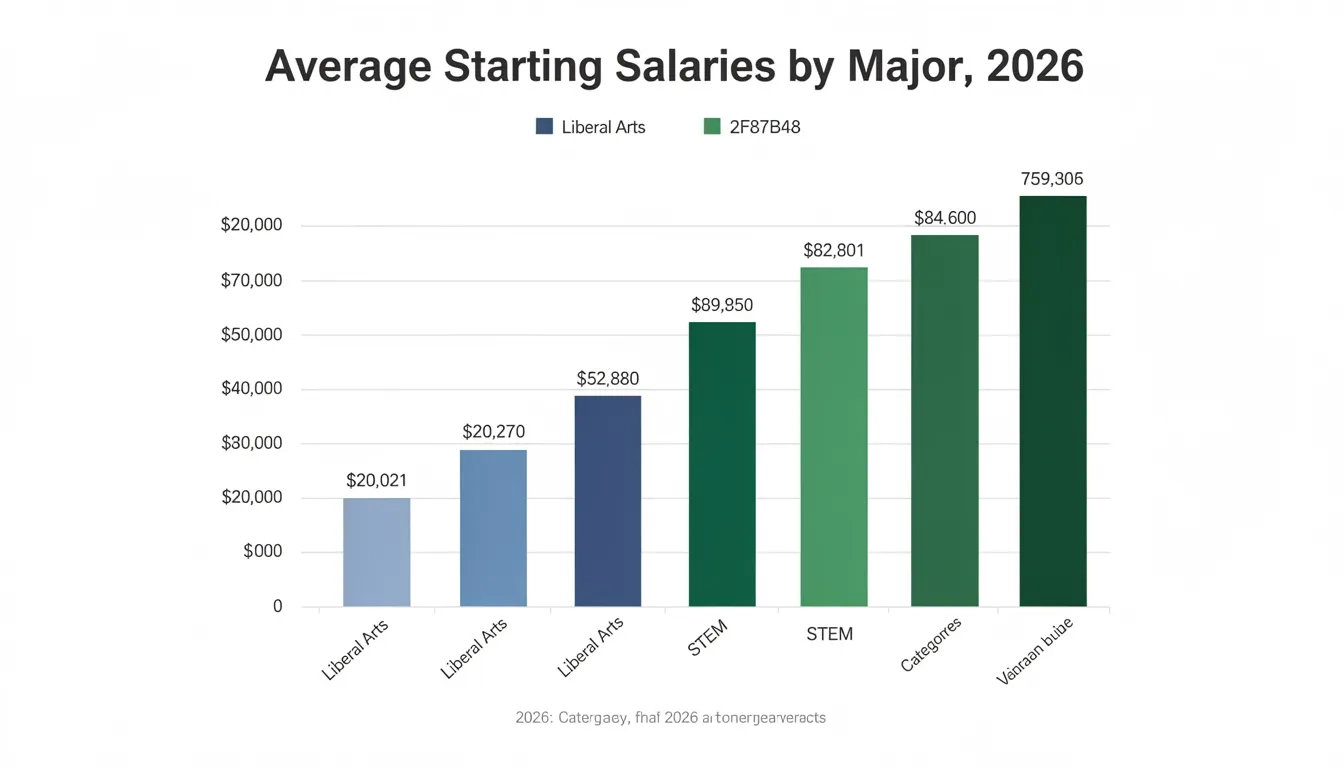
The headline numbers for 2026 are rough. Social sciences graduates are looking at a projected starting salary around $67,316, down from $69,802 just one survey cycle ago — a 3.6% drop. Communications graduates cluster around $60,353. If you've already heard that a liberal arts degree is a bad financial bet, those figures won't exactly calm you down.
But here's what that headline misses: 14 out of 19 humanities and arts majors produce median earnings above the 25th percentile of what STEM graduates earn. And 40 years out from graduation, the return on investment of a liberal arts degree sits 25% above the national median. The starting salary story and the lifetime earnings story are almost completely different articles.
Starting Salaries in 2026: The Real Numbers
The National Association of Colleges and Employers (NACE) published its Class of 2026 salary projections report earlier this year. The overall picture is actually positive — nearly every major category showed healthy projected increases ranging from 3.1% for engineering to 6.9% for computer sciences. The lone exception: social sciences, projected to drop another 1.7%.
PayScale's current data for BA in Liberal Arts holders shows an average base salary of $73,000 annually. That number covers workers at every experience level, which is where the story gets complicated.
For true entry-level graduates with less than a year of experience, the realistic range runs from $41,709 to $50,868. That's the number to hold in your head when planning post-graduation budgets.
The spread by employer type is also meaningful:
- Private companies: $46,128–$134,376
- Nonprofits: $40,527–$97,949
- Colleges and universities: $32,779–$105,704
So the sector you work in sets your ceiling, not just your floor.
The Major-by-Major Breakdown
Georgetown University's Center on Education and the Workforce released their "Major Payoff" report in October 2025, and the findings cut against the common stereotype.
For prime-age workers (roughly 35–54 years old), humanities and arts majors earn median salaries between $58,000 and $73,000. That's a surprisingly narrow band. Studio arts majors sit around $58,000 at the median; history majors land near $73,000. Less than a 26% difference between the lowest and highest earners in the entire field.
STEM shows a much wider spread: $64,000 at the low end (miscellaneous agriculture) up to $146,000 (petroleum engineering). Liberal arts pays less on average — but more predictably.
"14 of the 19 humanities and arts majors lead to median earnings above the 25th percentile of earnings for workers with STEM majors." — Georgetown CEW, Major Payoff Report (2025)
That 25th percentile of STEM earnings sits at $65,000. Which means most humanities majors, over a career, are competing in the solid middle of the labor market.
| Major Category | Entry-Level Avg. | Prime-Age Median |
|---|---|---|
| Engineering | $78,731 | $100,000+ |
| Computer Science | $76,251 | $95,000+ |
| Business | $65,276 | $86,000 |
| Social Sciences | $67,316 | ~$72,000 |
| Humanities & Arts | ~$48,000 | $69,000 |
| Communications | $60,353 | ~$65,000 |
Entry-level figures from NACE 2025 survey; prime-age medians from Georgetown CEW.
Industry Matters as Much as Major
The elephant in the room with liberal arts salary discussions: your industry selection matters as much as your major — maybe more.
Technology companies have been absorbing liberal arts graduates into product management, UX research, content strategy, and trust and safety roles for years. Roles like these frequently start at $65,000–$85,000 at mid-sized firms. Major tech employers push well above that at the senior end.
Management consulting is one of the most lucrative paths for liberal arts graduates who can demonstrate structured thinking and clear communication. Entry-level analyst roles at top-tier firms start between $70,000 and $90,000.
Compare that to:
- Nonprofit and social services: $40,000–$55,000
- K–12 education: $35,000–$52,000 depending on state
- Publishing and media: $42,000–$58,000
- Federal government entry-level (GS-7 to GS-9): $48,000–$65,000
A philosophy major who enters consulting will typically out-earn an English major who enters publishing by $20,000 or more in year one. That gap doesn't reflect ability or intelligence. It reflects industry economics. Industry selection is the biggest single lever a liberal arts graduate has on starting salary, and it's one that's frequently underweighted in major-selection conversations.
The Mid-Career Flip
Here's where the liberal arts earnings story genuinely improves. And where, frankly, it gets undersold.
PayScale's experience-level data shows the salary progression clearly:
- Entry level (under 1 year): $41,709–$50,868
- Early career (1–4 years): $40,093–$87,178
- Mid-career (5–9 years): $49,657–$125,179
- Late career (10–19 years): $51,930–$140,199
- Experienced (20+ years): $48,460–$153,096
The range widens dramatically with experience. A liberal arts graduate who develops real skills in communication, management, or strategic analysis over a decade can reach compensation levels that their starting salary would never have suggested.
Georgetown's long-term data confirms this trajectory. The skills liberal arts programs actually build (writing clearly under pressure, synthesizing complex arguments, persuading skeptical audiences) become more valuable as organizations grow more complex. Catherine Morris, senior editor at Georgetown's Center on Education and the Workforce, noted in 2025 that general fields like social sciences "offer greater labor market flexibility" and tend to be more stable during sectoral shocks than narrow technical specializations.
The catch is that this trajectory is not automatic. Liberal arts graduates who stay in low-growth industries or drift into roles that don't develop those skills don't see this arc. The long-term payoff requires deliberate career management.
The Graduate School Calculus
About 25% of liberal arts bachelor's degrees lack a positive standalone return on investment, according to Georgetown's research. That's worth sitting with.
For those graduates, strong earnings almost always run through an advanced credential. The options aren't all equal:
- Law school: Political science, philosophy, and history majors enter in large numbers. Median earnings for private-practice attorneys run well over $100,000.
- MBA: Top programs report average post-MBA salaries around $155,000. Liberal arts graduates get in regularly when they can demonstrate analytical track records.
- Professional master's degrees: MPP, MSW, MLIS, and similar credentials are often required to access the actual job. Salaries in public policy and social work range from $48,000 to $80,000 — modest, but the credential is the entry ticket.
- PhD: The academic market is genuinely difficult, but industry research and policy roles increasingly absorb PhDs at solid compensation.
Graduate school is not a fallback plan. It's a strategic escalation. But it only pays off if the credential maps to a specific job you want.
One clear mistake: enrolling in a second generalist humanities program without a defined career outcome. An MA in English that doesn't lead to a publishing role, a teaching credential, or a specific writing career isn't worth the tuition.
Where You Live Changes the Numbers
Geography is one of the most underappreciated variables in liberal arts salary outcomes. PayScale's city-level data shows dramatic variation:
| City | Salary Range for BA in Liberal Arts |
|---|---|
| Seattle | $86,325–$181,788 |
| Los Angeles | $83,524–$188,212 |
| New York | $48,936–$131,416 |
| National Average | $41,709–$153,096 |
Those Seattle and LA ceilings reflect late-career workers in tech-adjacent roles, not fresh graduates. But the directional insight is real: liberal arts graduates who concentrate in major coastal markets and enter well-paying industries earn substantially more than peers doing equivalent work in smaller cities.
New York's wide range tells its own story. The floor is low because media, publishing, and nonprofit work is concentrated there. The ceiling is high because finance, consulting, and tech are also concentrated there. Same degree, same city, dramatically different outcomes depending on which door you walk through.
What the 2026 Job Market Actually Looks Like
The broader employment context matters for 2026 graduates. Recent college graduates (ages 22–27) have faced elevated unemployment since 2022, higher than the broader workforce. Computer science saw 6.8% unemployment among recent graduates in 2022, while education majors saw just 2.2% — which shows that "STEM is safe" isn't a blanket rule.
For the Class of 2026, the labor market is more selective than it was during the hiring surge of 2021 and 2022. Bachelor's degree holders overall face 2.9% unemployment versus 6.2% for high school diploma holders, so the degree still buys meaningful protection from unemployment risk.
But employers can afford to be picky right now. A liberal arts graduate who pairs their writing and reasoning skills with even one concrete technical skill — SQL, data visualization in Tableau, digital advertising analytics — is not the same candidate as one who doesn't. That differentiation is what separates $48,000 starting offers from $65,000 ones in 2026.
Bottom Line
Liberal arts starting salaries in 2026 are lower than STEM, and that gap is not shrinking. Social sciences and communications grads are entering a market that's projecting flat or declining entry-level salaries for their fields.
But the long-term case is stronger than the entry-level snapshot suggests. Here's what I'd actually tell someone graduating this year:
- Pick your first industry deliberately. Consulting, tech, and finance pay liberal arts graduates 30–50% more at entry level than media, nonprofits, or education. If salary matters to you, this is your biggest variable.
- Add one concrete technical skill. Data literacy, SQL basics, or a marketable digital skill changes how recruiters evaluate your resume. This is table stakes in 2026.
- Don't ignore the mid-career trajectory. Georgetown's data is clear: the gap with STEM graduates narrows substantially over time. You are not locked in at your starting salary.
- Run the numbers on grad school before applying. About 25% of liberal arts BA holders see limited standalone ROI. If that's you, a targeted advanced credential can fix it. A second generalist degree usually won't.
- Location is a real input. If you want the top of the salary range, go where the industries that pay for your skills are concentrated.
Frequently Asked Questions
Is a liberal arts degree worth it financially in 2026?
For most graduates, yes — with caveats. Prime-age bachelor's degree holders in humanities earn a median of $69,000, and overall, college graduates earn 70% more than high school diploma holders. The degree pays off over a career, particularly for graduates who enter higher-paying industries and build complementary technical skills. The weakest returns show up for graduates who enter low-compensation sectors without a plan to move.
What is the average starting salary for a liberal arts graduate in 2026?
It depends sharply on field and industry. NACE data shows social sciences graduates averaging around $67,316 and communications graduates around $60,353 at entry level. Graduates entering consulting or tech roles can land $65,000–$85,000. Those going into nonprofits or education typically start between $40,000 and $52,000.
Do liberal arts majors catch up to STEM graduates over time?
Partially. Georgetown's research found that 14 of 19 humanities and arts majors produce median earnings above the 25th percentile of STEM earnings ($65,000). Long-term ROI sits 25% above the national median at the 40-year mark. The top-end STEM ceiling (software engineers, petroleum engineers) stays out of reach for most liberal arts career paths, but the middle of the market becomes quite competitive.
Which liberal arts majors earn the most?
Among traditional humanities fields, history majors earn the highest median salaries for prime-age workers ($73,000), while studio arts majors sit at the lower end ($58,000). Economics, often classified as a social science, is the strongest earner in the broader liberal arts umbrella and frequently produces entry-level salaries above $60,000. Philosophy majors who enter law or consulting also tend to out-earn peers who stay in directly "philosophical" work.
Is a liberal arts master's degree worth the investment?
Only if it leads to a specific credential or job. Professional programs — MPP, MSW, MFA for specific careers — can open doors that a bachelor's degree can't. A second generalist humanities master's degree usually doesn't improve earnings enough to justify tuition. About 25% of liberal arts BA holders see meaningful salary improvement with the right advanced credential; the key word is "right."
What skills help liberal arts graduates earn more in 2026?
Data literacy is the clearest differentiator right now. Liberal arts graduates who can work with Excel at an intermediate level, read a SQL query, or interpret a Tableau dashboard compete for a meaningfully different (and larger) set of roles than those who can't. Beyond data, demonstrated project management experience, a track record in digital marketing with measurable results, and foreign language fluency in high-demand markets all show up in employer hiring preferences for 2026.
Sources
- Class of 2026 Salary Projections Are Promising — NACE
- Average College Starting Salary Projections 2025 — BestColleges
- The Major Payoff: Earnings and Employment Outcomes Across Bachelor's Degrees — Georgetown CEW
- In "Rocky" Labor Market, Your College Major Matters — Inside Higher Ed
- Bachelor of Arts (BA), Liberal Arts Salary — PayScale