Conference Realignment and Students: What the Travel Numbers Actually Mean
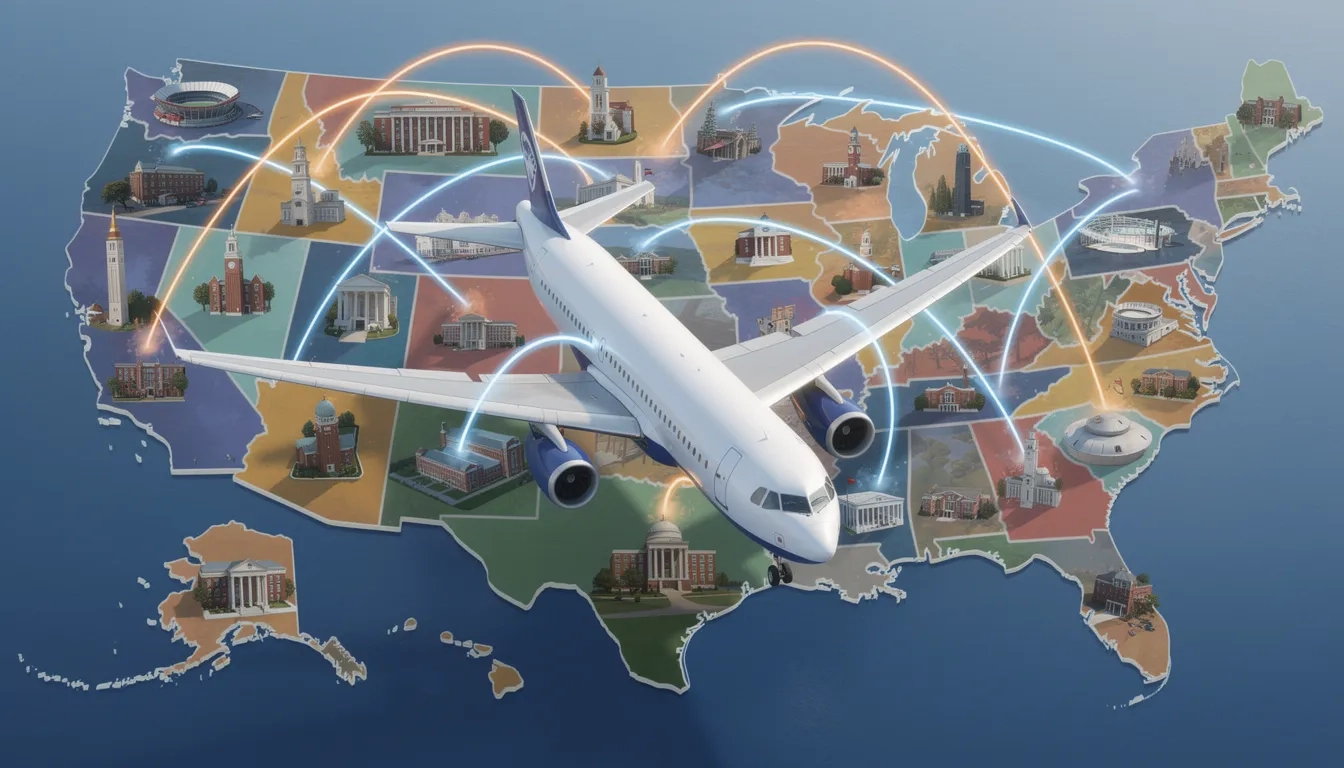
The Oregon Ducks men's basketball team traveled 26,700 miles during the 2024-25 season. The year before, when they were still in the Pac-12, they covered 7,327 miles. That's a 265% jump. Not because the sport changed. Not because the schedule got longer. Because someone in a conference office decided Oregon belonged in the Big Ten.
That number is a good place to start if you want to understand what conference realignment is actually doing to students.
A Quick Map of What Changed
The reshuffling that's been playing out since 2022 fundamentally rewired the geography of college sports. The Pac-12, which had been a functioning West Coast conference for over a century, effectively collapsed. Washington and Oregon bolted for the Big Ten. USC and UCLA had already gone. Stanford and Cal landed in the ACC.
The Big Ten now has 18 members stretching from New Jersey to Los Angeles. That's not a conference. That's a cross-country airline route.
Here's where the major movers ended up:
| School | Former Conference | New Conference |
|---|---|---|
| UCLA | Pac-12 | Big Ten |
| USC | Pac-12 | Big Ten |
| Oregon | Pac-12 | Big Ten |
| Washington | Pac-12 | Big Ten |
| Stanford | Pac-12 | ACC |
| Cal (UC Berkeley) | Pac-12 | ACC |
| Arizona | Pac-12 | Big 12 |
| Colorado | Pac-12 | Big 12 |
| Oklahoma | Big 12 | SEC |
| Texas | Big 12 | SEC |
The schools driving these moves were chasing TV money. The Big Ten signed a seven-year, $7 billion media rights deal. The SEC isn't far behind. The logic is entirely financial, and the people making the decisions are not the ones sitting in 5 a.m. study halls after red-eye flights.
Missing Class Is Now Just Part of the Deal
Academic disruption has gone from an occasional inconvenience to a structural feature of what it means to play college sports at a major program. Maryland baseball had a stretch during the 2024-25 season with five games spread across Penn State, JMU, and Minnesota inside a single week. The team wasn't on campus once.
A 2021 study published in the Journal for the Study of Sports and Athletes in Education surveyed Big Ten football players and found they reported reduced time for homework, inability to join extracurricular organizations, and what one player described as "high level of fatigue from traveling" that made attending office hours practically impossible.
Sage Ennis, who played football for Clemson's ACC program while enrolled as a graduate student at the University of Virginia, put it plainly: maintaining academic and athletic excellence becomes meaningfully harder when "jet lag, physical fatigue, and mental irritation" from cross-timezone travel are part of your weekly routine.
What's changed post-realignment isn't that this was never a problem. It's that the distances involved now make the problem chronic instead of occasional.
- Athletes traveling for midweek games often don't return until 3 or 4 a.m.
- Time zone differences mean deadlines that look manageable on a syllabus become impossible in practice.
- Professors who grant makeup accommodations can't always reschedule group projects or lab sessions.
- Not all academic support staff travel with teams, so athletes are often on their own.
The Non-Revenue Sports Problem
Here's the part that gets buried under football coverage: the students bearing the heaviest academic load from realignment are mostly not the ones you see on ESPN.
Women's volleyball runs a 30-game season that includes frequent midweek matches. Baseball and softball teams play over 50 games, many on weekdays. Stanford women's volleyball traveled 33,700 miles during the 2024-25 ACC season. That's triple what they logged in their final Pac-12 season. Stanford and Cal's women's basketball programs each crossed 23,000 miles in their first ACC year.
Football players, at least at major programs, travel on charter flights and arrive at hotels with dedicated academic support staff. A women's golfer flying commercial to a Tuesday tournament in a different time zone does not have the same infrastructure.
"Sports like women's soccer were an afterthought in the decision to change conferences." — widely reported framing from athletes and analysts in the 2024 realignment cycle.
Amanda Paule-Koba, a sport management professor at Bowling Green State University, has argued that universities need to "invest back in the people who are generating that money" rather than redirecting revenue toward coaching salaries and facility arms races. The argument is direct and the evidence supports it.
The financial logic of realignment is built on football and men's basketball. Every other sport gets swept along for the ride.
The Physical and Mental Toll
Chronic travel has measurable physical effects. Disrupted sleep, circadian rhythm shifts, and reduced recovery time all show up in performance and health data.
The Big Ten's 18-team football programs collectively traveled approximately 158,000 miles during the 2024 season — the equivalent of circling the earth six times. At some point, that's not athletics. That's logistics management with a jersey on.
USC men's basketball coach Eric Musselman described his own experience this way: "I'm so exhausted. My wife said she's never seen me so sick throughout the college basketball season." If the head coach is saying that publicly, what are the 19-year-old players saying privately?
A 2019 study of 108 college athletes found that while players enjoyed visiting new campuses, the large majority reported negative effects on:
- Athletic performance due to fatigue and disrupted training schedules
- Academic work from missed class time and compressed study windows
- Personal relationships from being geographically cut off from their home campus community
The mental health dimension is under-researched but not invisible. A 2023 NCAA health and wellness study found 67% of women's sport athletes wished coaches and administrators talked more about mental wellness. Realignment adds load to a system already running close to capacity.
What Happens to Students Who Aren't Athletes
The effects don't stop at the athlete population. Conference realignment changes what it means to be a student fan at a school like Oregon or UCLA.
When rivalry games disappear, so do the social anchors they provide. Oregon and Washington played each other in football for over a century. That rivalry moved to the Big Ten's scheduling calendar and promptly vanished as a meaningful annual matchup. These aren't just games. For students, these games are homecoming events, traditions that shape campus identity, and reasons to stay engaged with their institution.
The fan travel math also shifts. A UCLA student who wants to follow their team to an away game now faces flights to Rutgers or Michigan instead of a manageable drive to Arizona. The games are on TV, sure, but the atmosphere of actually attending college sports as a fan becomes economically inaccessible for most students.
There's a subtler effect worth naming: conference identity shapes recruiting conversations. Prospective students, not just athletes, make choices about where to apply partly based on what kind of school a place feels like. A West Coast school in a Midwest conference sends a mixed signal about institutional identity that college counselors and admissions offices haven't fully figured out how to address yet.
Program Cuts Are the Other Side of the Equation
The financial pressures that drove realignment didn't stop once the conferences locked in their new memberships. The $2.8 billion House v. NCAA antitrust settlement (which established revenue sharing with athletes) forced athletic departments to rethink their entire budget structures.
More than 415 collegiate Olympic sports programs have been cut, merged, or reclassified since May 2024. Cal Poly eliminated both its men's and women's swimming programs in March 2025. These are students who chose a school partly because that sport was available to them.
The calculus is brutal and fairly simple:
- Football revenue funds most athletic departments
- Revenue sharing now requires paying athletes directly
- Non-revenue sports become line items to cut
- Students who competed in those sports lose their programs
The realignment wave and the NIL/settlement wave are hitting simultaneously. Athletes in Olympic sports who survived the travel burden are now watching their programs get eliminated anyway, often with little notice and limited recourse.
What Would Actually Help
I'll be direct: most of the "solutions" floated by conference offices involve scheduling tweaks that don't touch the underlying geography problem. Moving some games to weekends doesn't fix the fact that a team from Los Angeles has no business playing a conference schedule in Maryland.
But some targeted changes would make a real difference:
- Hard caps on weekly travel distance for non-football, non-basketball programs, enforceable at the conference level
- Required travel support staff ratios tied to conference size, so Olympic sport athletes have the same academic resources football players get
- Scheduling protections around midterm and final exam weeks, standardized across all conference members
- Genuine student input in realignment decisions — not a survey after the press release, but representatives in the room when geography-redefining choices get made
The uncomfortable reality is that none of the schools making realignment decisions are primarily weighing student welfare. They're weighing TV contracts. That's not cynicism. That's just what the public record shows.
Bottom Line
- If you're a student athlete at a school that recently changed conferences, your academic load just got harder structurally, not because you're less capable. Plan for it by front-loading assignments before travel weeks and having explicit conversations with professors at the start of each semester.
- Non-revenue sport athletes should understand that their programs are more financially vulnerable than they were five years ago. Knowing your program's budget situation is not paranoid — it's practical.
- For non-athlete students, the conference shift changes your fan experience and campus culture whether you want it to or not. Pay attention to which rivalries and traditions your school is letting go, and push back through student government when those losses feel unnecessary.
- The core argument here is that realignment was designed by and for athletic departments and television networks, and students of all kinds are absorbing costs that were never factored into the original math. That won't change until students are treated as stakeholders rather than an afterthought.
Frequently Asked Questions
Does conference realignment actually affect students who aren't athletes?
Yes, in ways that aren't always obvious. Campus culture, rivalry traditions, and school identity all get reshaped when a conference affiliation changes. Students who grew up rooting for regional rivalries may find those games gone, replaced by matchups with no historical significance. Recruiting conversations also shift — prospective students increasingly factor conference identity into their sense of what a school's culture looks like.
Which sports are most affected by the travel increase from realignment?
Non-revenue sports take the heaviest hit. Women's volleyball, baseball, softball, swimming, golf, and track and field programs have long midweek schedules and far fewer charter flight arrangements than football or men's basketball. Stanford women's volleyball, for example, traveled more than 33,700 miles in their first ACC season — three times their final Pac-12 total — mostly in conditions that revenue sports athletes don't face.
Isn't more travel a net positive for athletes who get to see new places?
A 2019 study of 108 college athletes found that while most players enjoyed visiting new campuses, the large majority still reported negative effects on academic performance, athletic results, and personal relationships. Enjoying a trip and being able to function academically during it are different things. When travel hits 26,000+ miles in a single season, the novelty argument wears thin fast.
Are conference realignment decisions likely to reverse?
Most analysts think the current configuration — with the Big Ten and SEC operating as 16-to-18-team superconferences — is unstable over a 10-to-15-year horizon. Nobody in college sports seriously argues the current geography is sustainable. But the money flowing from TV deals makes the short-term incentives too strong to pull back from voluntarily. Change is more likely to come from NCAA governance reform or legal pressure than from conference offices deciding to act in athletes' interests unprompted.
What can student athletes do right now to protect their academics during heavy travel?
Start every semester by meeting with your academic advisor specifically to map travel weeks against assignment deadlines. Flag the hardest conflicts in writing at the start of the term, not the night before. Take online or asynchronous sections when available, particularly for courses with frequent labs or group sessions. And don't assume professors know your travel schedule — athletic-academic liaisons exist partly to make that communication happen, so use them.
Is the wave of program cuts connected to conference realignment?
Directly and indirectly. Realignment drives up travel costs for athletic departments across all sports. Simultaneously, the $2.8 billion House v. NCAA settlement requires schools to share revenue with athletes, which squeezes budgets further. Non-revenue sports sit at the intersection of both pressures. More than 415 programs have been eliminated or restructured since May 2024, and that number is still climbing.
Sources
- NCAA Conference Realignment Travel Strains Athletes, Teams And The Planet - Sport Positive Summit
- Conference Realignment Poses Mental and Physical Risks to College Athletes - BestColleges
- NCAA Conference Realignment and the Consequences for Student-Athletes - Jandoli Institute
- College Sports Realignment: How Travel Impacts Student-Athletes - MyNextPlay
- The cost of college conference realignment - NBC News
- Conference Realignment May Have Unintended Consequences for Student Athletes in Non-Revenue Sports