Boston University: Programs, Rankings, and What Campus Life Is Actually Like
Boston University climbed from #108 to #88 in the QS World University Rankings between 2025 and 2026. That's a 20-spot jump in a single year — not the kind of movement you see at schools coasting on reputation. It signals something deliberate. And when you look at the program-level data, the research investment, and what students actually say about living in Boston for four years, the trajectory starts to make sense.
Where BU Stands in the Rankings Right Now
In U.S. News & World Report's 2026 edition, BU sits at #42 among National Universities — holding steady in territory it entered after joining the Association of American Universities in 2012 as the 62nd member institution. That AAU membership matters. It's a selective research consortium, and getting in signals that peer institutions see you as a serious research operation.
The subject-level rankings tell a more interesting story than the headline number. Public Health ranks #16 globally according to the ARWU Shanghai Rankings 2025 — an unusually high placement for a program that rarely leads BU's marketing materials. Business Analytics earned a #27 worldwide ranking in the QS Masters category for 2026.
| Program | Ranking Source | Rank (2025/2026) |
|---|---|---|
| Overall (National) | U.S. News 2026 | #42 |
| QS World University | QS 2026 | #88 |
| Public Health | ARWU Shanghai 2025 | #16 |
| MBA | QS Rankings 2026 | #36 |
| Business Analytics (Masters) | QS Rankings 2026 | #27 |
| Questrom School of Business | Financial Times 2025 | #30 in USA |
Times Higher Education places BU's Computer Science in the 101-125 band globally. That band still means top 125 programs out of thousands worldwide. It just means BU isn't MIT, which is five miles up the road.
The Schools and Programs Worth Knowing About
BU runs 17 schools and colleges along 1.5 miles of Commonwealth Avenue. Most universities this size consolidate into 8-10 colleges. The result here is that niche fields get dedicated homes rather than getting absorbed into massive catch-all departments. That matters when you're choosing where to spend four years.
The Questrom School of Business gets the most attention. Its graduate programs in analytics consistently outperform the school's overall ranking, and for data-minded MBA students, Questrom competes with schools ranked 10 spots higher overall.
The College of Communication is probably BU's most underrated asset. Journalism, film/TV, PR, and advertising all share one building. The proximity to Boston's media market means students are doing real reporting and real PR work from year one. Not simulations. Real work.
Other schools worth knowing:
- Henry M. Goldman School of Dental Medicine: ranked #45 globally by QS 2025 — one of the stronger dental programs in the country
- Chobanian & Avedisian School of Medicine: feeds directly into Boston's hospital system, including Boston Medical Center as an affiliate
- College of Engineering: growing fast, with particular strength in bioengineering and photonics research
- School of Law: solid regional standing, particularly for students planning to practice in the Northeast
BU offers 300+ majors and minors across these schools. That's not a marketing number. It's a practical advantage if you want to combine journalism and computer science, or business and neuroscience, in ways that don't usually sit next to each other at other universities.
Research, Innovation, and What $579 Million Buys
In fiscal year 2024, Boston University received $579.5 million in total research awards. That placed it #16 among private research universities nationally by R&D expenditures. Those funds support 1,549 active laboratories across campus.
The telephone was invented in a BU lab. Alexander Graham Bell was a professor at the School of Oratory when he made the first successful call in 1876. That specific historical fact matters because applied research becoming world-changing technology has been part of BU's character for 150 years — it's not a recent branding exercise.
BU's current research priorities span cloud computing and cybersecurity, infectious diseases, photonics, neuroscience, and urban policy — fields where the institution has built genuine depth rather than spreading thin.
The infectious disease work deserves particular attention. BU's National Emerging Infectious Diseases Laboratories (NEIDL) is one of only two BSL-4 facilities in the U.S. located on an urban university campus. It drew significant scientific activity during COVID-19 research and attracts faculty talent that smaller programs can't compete for.
The $4.045 billion endowment (2025) funds these priorities. It's not Harvard's $50 billion, but it's large enough to sustain serious faculty recruitment and lab infrastructure without chasing every federal grant cycle.
Getting In: Admissions Numbers and What They Mean
The Class of 2029 acceptance rate was 12.83%, down sharply from around 19% just five years earlier. Over 76,000 applications competed for roughly 3,461 enrolled seats. The middle 50% SAT range was 1430-1540, with an average GPA of 3.87.
Here's what those numbers actually mean: Early Decision is a significant lever. About 59% of the enrolled Class of 2029 came through ED1 or ED2. Regular decision applicants faced odds closer to 5-7%. If BU is your genuine first choice, applying ED1 is probably the single highest-impact move you can make.
The class profile reflects real diversity: 58.2% students of color, 21% international students from 68 countries, and approximately 20% first-generation college students.
Annual cost breakdown for 2025-2026:
- Tuition and fees: $71,372
- Total estimated cost of attendance: approximately $90,000/year
- Pell Grant recipients: ~20% of enrolled class
BU meets 100% of demonstrated financial need for domestic students. The sticker price is real; the net price depends heavily on your family's situation. Running the net price calculator before being scared off by the headline number is worth the 10 minutes.
Campus Life: Living on Commonwealth Avenue
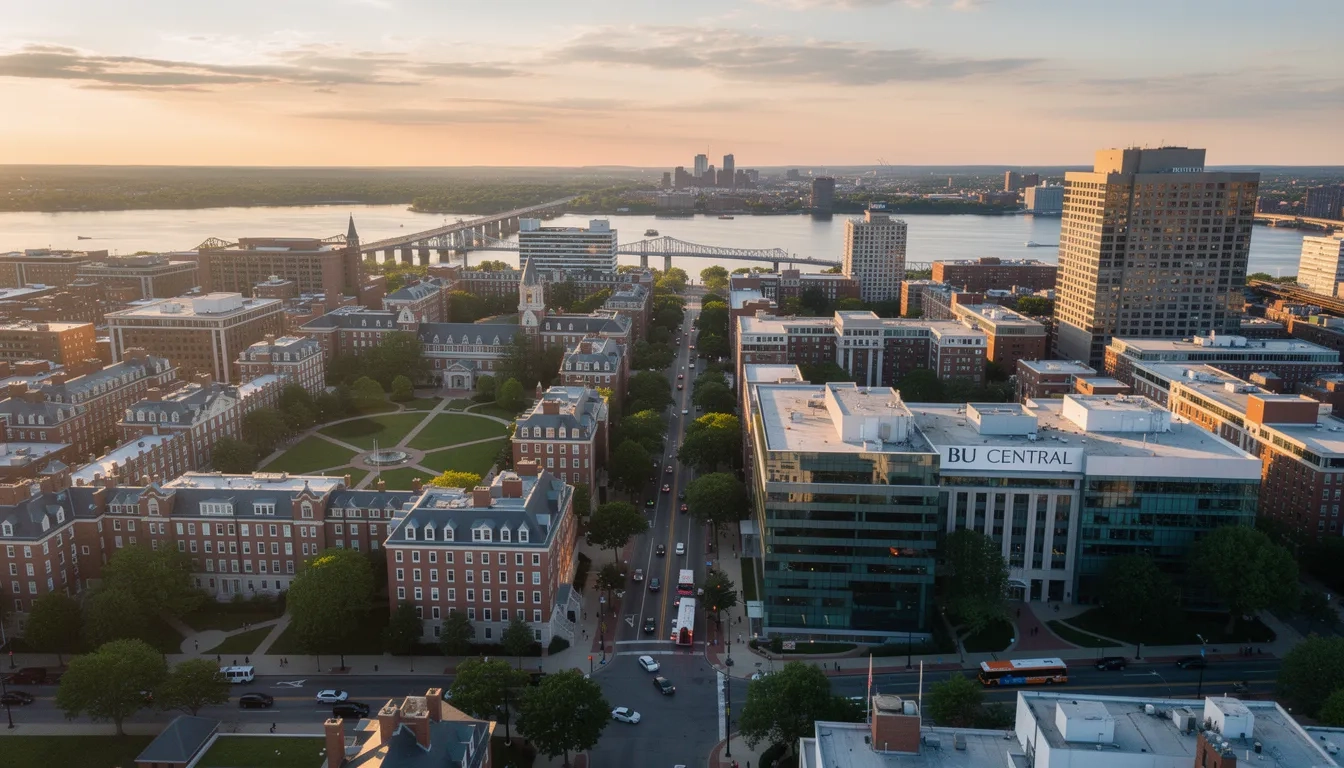
The campus stretches along Commonwealth Avenue in Boston's Allston-Brighton neighborhood, right along the Charles River. There's no traditional quad. BU is a city school, and that's not a flaw — it's the whole design.
Warren Towers is the second-largest non-military dormitory in the United States, housing over 1,800 students in one building. If you're a first-year looking for an instantly social environment, Warren is the hub. Loud, dense, and exactly what most 18-year-olds need when arriving somewhere new. The university also guarantees four years of on-campus housing for all undergraduates who want it, which is rare at large research universities — essentially unheard of in a city as expensive as Boston.
Social life clusters around a few specific spots:
- BU Beach: a grassy strip along the Charles River where students gather in warm weather for picnics, frisbee, and generally avoiding studying
- COM Lawn: hosts food trucks and outdoor events throughout the year
- Saxbys and Pavement: on-campus cafes that function as de facto study halls and social hubs
Beyond campus, the MBTA Green Line runs directly along Commonwealth Avenue with multiple stops serving BU. Getting to downtown Boston, Fenway, or the Longwood Medical Area takes under 20 minutes. Students who don't use the T at least once a week are leaving one of the best parts of a BU education on the table.
Over 450 student organizations run everything from Mock Trial to Korean cultural groups to niche engineering societies. The twice-yearly Splash fair is how most students first encounter this ecosystem — arriving early is worth it, because the more active clubs fill quickly. BU was also one of only 16 colleges named to the Princeton Review's inaugural 2025 Mental Health Services Honor Roll (a list that drew from hundreds of applicants), reflecting genuine counseling infrastructure investment rather than just wellness buzzwords.
Athletics, the Social Scene, and the BU Vibe
BU competes in NCAA Division I across 24 varsity sports. Hockey is the institutional soul. Both the men's and women's programs play in Hockey East, one of college hockey's premier conferences, and the men's program has produced 30 NHL first-round draft picks over the decades. Games at Agganis Arena run cheap on student tickets and are a genuinely good time.
BU dropped football in 1997. This still surprises prospective students, and it does shape the fall social calendar. No Saturday tailgates, no homecoming game in the traditional sense. But the athletic budget flows deeper into programs that compete at an elite level instead of subsidizing a sport with limited competitive upside.
The student body skews academically serious. BU has a reputation as a place where students work hard and also manage a real social life in a genuinely great city. If you want Big Ten football culture and Greek-life-dominated weekends, there are better fits. But if you want to intern at a Boston biotech firm your sophomore year and walk to a concert at the House of Blues afterward, BU is hard to beat.
The new six-day orientation program launched in fall 2025 brought 4,200 incoming students through a redesigned experience — starting virtually in May and culminating with a Matriculation Ceremony on August 29. The shift toward a week-long, immersive format rather than a compressed two-day scramble reflects what Dean of Students Jason Campbell-Foster described as "an invitation to engage deeply in our programs and our community."
Bottom Line
- Apply Early Decision if BU is genuinely your first choice. It nearly doubled admission odds for the Class of 2029 compared to regular decision. Do not treat the two paths as equivalent.
- Match your program to BU's real strengths. Public Health, Business Analytics, Communication, and Bioengineering consistently outperform the school's overall ranking. These are areas where you're getting more than the #42 headline suggests.
- Run the net price calculator before the sticker price scares you. BU meets 100% of demonstrated need for domestic students, and $71,372 is rarely what families actually pay.
- Take the city seriously as part of your education. Boston's hospitals, biotech firms, media companies, and law firms are accessible from day one — not just post-graduation.
- The 20-spot jump in QS rankings in one year signals an institution actively building. That trajectory matters for how your degree is perceived a decade from now.
Frequently Asked Questions
Is Boston University considered a prestigious university?
Yes, and the data supports it. BU sits at #42 nationally (U.S. News 2026) and #88 globally (QS 2026), with membership in the Association of American Universities — a research consortium of 68 selective institutions. It's not an Ivy, but it operates in the same research tier as universities that often carry more name recognition.
What is Boston University's strongest academic program?
It genuinely depends on the field. Public Health is arguably BU's highest-ranked individual program at #16 globally (ARWU 2025). Business Analytics through Questrom ranks #27 worldwide at the graduate level. The College of Communication has an industry reputation that outpaces its formal rankings, particularly for students entering Boston's media and public relations markets.
How hard is it to get into Boston University?
For the Class of 2029, the overall acceptance rate was 12.83%, but regular decision odds fell to roughly 5-7%. The average admitted GPA was 3.87, with a mid-50% SAT range of 1430-1540. Early Decision applicants saw roughly 29% acceptance — a gap large enough that it should factor into any serious application strategy.
Does BU have a good social scene without a football team?
The social scene runs through hockey games, 450+ student organizations, and Boston itself. Students who lean into the city — concerts, neighborhoods, professional networking — tend to be the most satisfied. Those expecting a traditional Midwestern football-Saturday atmosphere will need to recalibrate expectations. It's a different kind of college experience, not a lesser one.
What does Boston University cost, and is financial aid real?
Tuition and fees are $71,372 for 2025-2026, with total cost of attendance around $90,000/year. BU meets 100% of demonstrated financial need for domestic undergraduates. About 20% of enrolled students are Pell Grant recipients, which indicates meaningful aid availability across income ranges.
Is BU a good fit for undergraduates who want research experience?
Strong yes. With $579.5 million in annual research awards, R1 classification, and 1,549 active laboratories, BU's undergraduate research opportunities run deeper than most schools ranked nearby. The NEIDL biosafety lab, photonics centers, and neuroscience institutes actively involve undergraduates. Research connections tend to happen through faculty relationships and structured programs — students who seek them out early get far more than those who wait until junior year.
Sources
- Answering Your Top Questions About Boston University Student Life | Hey BU Blog
- BU's New Orientation Week: A Fully Immersive, Weeklong Start to Campus Life
- Boston University - Wikipedia
- Boston University Acceptance Rate Analysis 2025 - Admit Studio
- Boston University Profile, Rankings and Data | U.S. News Best Colleges
- Boston University Ranking 2026: QS & World Rankings - Yocket